
Introduction to Ecommerce Platforms
In the digital age, ecommerce has become a cornerstone of global retail. By 2024, global ecommerce sales are projected to reach $6.4 trillion, accounting for 22% of total retail sales worldwide (Statista, 2023). This explosive growth underscores the critical importance of choosing the right ecommerce platform for businesses of all sizes.
A. Importance of choosing the right ecommerce platform
Selecting an appropriate ecommerce platform can make or break an online business. Consider these statistics:
- 88% of online shoppers are less likely to return to a website after a poor user experience (Amazon Web Services, 2023)
- Websites that load within 2 seconds have an average conversion rate of 37%, compared to 29% for those that take 3 seconds or longer (Portent, 2022)
- 57% of customers have stopped buying from a company because a competitor provided a better experience (Salesforce, 2023)
These numbers highlight how crucial it is to choose a platform that offers speed, reliability, and a seamless user experience.
B. Brief overview of what to consider
When evaluating ecommerce platforms, businesses should consider:
- Scalability: Can the platform grow with your business?
- Customization: How flexible is the platform in terms of design and functionality?
- Integration capabilities: Does it work well with your existing systems?
- Security: What measures are in place to protect customer data?
- Cost: What’s the total cost of ownership, including setup, maintenance, and transaction fees?
Example: Shopify, one of the leading ecommerce platforms, powers over 4 million websites globally (Shopify, 2024). Its success can be attributed to its balance of ease of use, scalability, and robust feature set, making it suitable for businesses ranging from small startups to large enterprises.
In the following chapters, we’ll dive deeper into the history, evolution, and key players in the ecommerce platform landscape, providing you with the knowledge to make an informed decision for your business.
History of Ecommerce Platforms
The evolution of ecommerce platforms mirrors the rapid advancement of internet technologies over the past three decades. This chapter explores the key milestones in this journey.
A. Early days of online selling (1990s)
The 1990s marked the dawn of ecommerce:
- 1991: The National Science Foundation lifted restrictions on commercial use of the Internet
- 1994: Netscape Navigator, the first commercial web browser, was released
- 1995: Amazon and eBay were founded, pioneering new models of online retail
In these early days, ecommerce was primarily custom-built solutions requiring significant technical expertise. The first online sale is often attributed to a Sting CD sold on NetMarket in August 1994.
B. Rise of dedicated ecommerce solutions (2000s)
The 2000s saw the emergence of platforms designed specifically for ecommerce:
- 2000: Salesforce launches, introducing the SaaS model to enterprise software
- 2003: Magento (originally Varien) is founded
- 2004: Shopify is established
- 2006: Wix launches its website builder
By 2007, ecommerce sales in the U.S. reached $136.4 billion, marking a 19% increase from the previous year (U.S. Census Bureau).
C. Shift towards cloud-based platforms (2010s)
The 2010s brought a significant shift towards cloud-based, user-friendly platforms:
- 2011: WooCommerce is released as a WordPress plugin
- 2013: Shopify introduces its iPad POS system, bridging online and offline retail
- 2015: BigCommerce launches its enterprise ecommerce platform
By 2019, global ecommerce sales hit $3.5 trillion, with mobile commerce accounting for 67.2% of digital sales (Statista, 2020).
Example: Shopify’s growth exemplifies the cloud platform boom. In 2012, it had 41,000 merchants. By 2022, this number had grown to over 2 million, showcasing the rapid adoption of cloud-based ecommerce solutions.
This historical context sets the stage for understanding the current ecommerce platform landscape and its future trajectory.
Evolution of Ecommerce Platforms
The ecommerce platform landscape has undergone significant transformations, driven by technological advancements and changing consumer behaviors.
A. From custom-built to off-the-shelf solutions
In the early days, ecommerce sites were primarily custom-built, requiring significant time and resources:
- 1995: It took an average of $100,000 and 3 months to build an ecommerce website
- 2005: Off-the-shelf solutions reduced this to $20,000 and 1 month
- 2024: Platforms like Shopify allow stores to be set up in hours for as little as $29/month
This shift has dramatically lowered the barrier to entry for online businesses.
B. Emergence of open-source platforms
Open-source platforms have played a crucial role in democratizing ecommerce:
- 2003: osCommerce, one of the first open-source ecommerce platforms, gains popularity
- 2008: Magento is released, quickly becoming a favorite for its flexibility
- 2011: WooCommerce launches, now powering 28% of all online stores (BuiltWith, 2024)
These platforms offer greater customization options and lower costs, but often require more technical expertise to manage.
C. Growth of SaaS (Software as a Service) models
SaaS models have transformed how businesses approach ecommerce:
- 2006: Shopify launches, pioneering the SaaS model for ecommerce
- 2015: BigCommerce goes public, validating the SaaS ecommerce model
- 2024: Over 60% of ecommerce businesses use SaaS platforms (Gartner, 2024)
SaaS platforms offer ease of use, regular updates, and scalability, making them popular among businesses of all sizes.
D. Integration with other business systems (ERP, CRM)
Modern ecommerce platforms emphasize integration:
- 2010: Less than 20% of ecommerce platforms offered native ERP integration
- 2024: Over 80% of leading platforms provide built-in or easy integration with major ERP and CRM systems
Example: Shopify’s App Store offers over 6,000 integrations, allowing businesses to connect their online store with accounting software, marketing tools, and more.
This evolution reflects a shift towards more holistic, integrated business solutions, enabling smoother operations and better customer experiences.
Evolving Features of Ecommerce Platforms
As technology advances and consumer expectations shift, ecommerce platforms continually evolve to offer new features and capabilities.
A. Mobile responsiveness and apps
Mobile commerce has become crucial:
- 2010: Mobile accounted for 3% of ecommerce sales
- 2024: Mobile commerce is projected to reach 72.9% of total ecommerce sales (Statista, 2024)
All major platforms now offer mobile-responsive designs and dedicated mobile apps. For instance, Shopify’s mobile app allows merchants to manage their stores on the go, with over 1 million active installations.
B. Advanced analytics and reporting
Data-driven decision making is now standard:
- 2015: Basic sales and traffic reports were the norm
- 2024: AI-powered predictive analytics and real-time dashboards are common
Example: BigCommerce’s Insights feature provides over 50 pre-built reports and supports custom report creation, helping merchants make data-informed decisions.
C. Multichannel and omnichannel capabilities
Platforms now support selling across multiple channels:
- 2010: Most platforms focused solely on website sales
- 2024: Leading platforms integrate with marketplaces, social media, and physical POS systems
Shopify, for instance, allows merchants to sell on 100+ channels, including Facebook, Instagram, and Amazon, from a single dashboard.
D. Personalization and AI-driven recommendations
Personalization has become a key differentiator:
- 80% of consumers are more likely to purchase from brands that offer personalized experiences (Epsilon, 2023)
- AI-driven product recommendations can increase conversion rates by up to 915% (Monetate, 2022)
Platforms like Magento now offer built-in AI capabilities for personalized product recommendations and dynamic pricing.
E. Enhanced security measures
As cyber threats evolve, so do security features:
- 2010: Basic SSL encryption was the standard
- 2024: Advanced features like fraud detection, DDoS protection, and PCI DSS compliance are common
For example, Shopify automatically provides Level 1 PCI DSS compliance for all its stores, the highest level of certification available.
F. Social media integration
Social commerce is rapidly growing:
- Social commerce sales are expected to reach $2.9 trillion by 2026 (Statista, 2023)
Platforms now offer deep social media integration. WooCommerce, for instance, provides plugins for direct selling on Instagram and Facebook shops.
These evolving features reflect the dynamic nature of ecommerce, with platforms continuously adapting to meet the changing needs of businesses and consumers alike.
Best Ecommerce Platforms
In this section, we are going to review the best ecommerce platforms. introduce them, the present the features, pros/cons, and pricing.
#1 – Sellfy
Sellfy is the most user-friendly e-commerce platform available for small internet retailers. Small business owners and content creators are particularly fond of it. Worldwide, more than 270,000 creators use it.
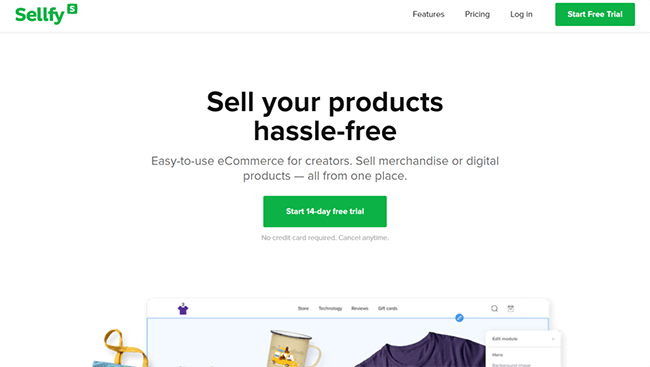
Some other platforms on this list also support sales of digital goods, but none of them are as good at it as Sellfy.
While a few other sites on this list facilitate digital products sales as well, none are as proficient in this area as Sellfy.
Sellfy was created expressly to satisfy the needs of photographers, musicians, and other artists who wish to sell their products online, in contrast to other e-commerce platforms.
You can use it to sell subscriptions, ebooks, audio files, films, pictures, PSD files, and any other digital file type you can think of. You may even provide clients with on-demand access to exclusive videos by using Sellfy’s video streaming capabilities.
Furthermore, you are not restricted to selling only through your internet business. Using Selfie, you can add buy now buttons to any webpage on the internet or social network. You can make money from your blog or YouTube channel if you already have a following by including Sellfy “product cards” in your posts, YouTube cards, and end screens.
Sellfy is excellent for selling print-on-demand (POD) goods like t-shirts, hoodies, and mugs in addition to digital downloads. Print-on-demand functionality is integrated into the site; just make your designs, start selling, and Sellfy will take care of the rest, printing and fulfilling orders as they come in.
| Pros | Cons |
| Ideal for selling digital goods & subscriptions | Less flexible than other platforms |
| Built-in POD sales tools | |
| Sell video on demand content | |
| Email marketing functionality included |
Pricing:
Paid plans that allow you to connect your own domain start at $19/month (billed bi-annually).
Sellfy offers a 30-day money back guarantee.
#2 – Shopify
Shopify is undoubtedly the most well-known ecommerce platform on the market. It’s a fully hosted, all-in-one platform that distinguishes itself with an enormous array of third-party tool integrations.

One of the first businesses to offer a way for non-web engineers to create their own stores was Shopify, which was founded in 2006. Like BigCom/merce, it’s meant to give everything you need to run your internet business in one spot.
Thanks to the user-friendly site builder and superior theme selection, creating a completely responsive Shopify store and getting everything up and running simply takes a few minutes.
However, Shopify’s vast array of connectors is what sets it apart. In terms of the quantity of third-party integrations, it is surpassed only by WordPress/WooCommerce.
However, Shopify’s vast array of connectors is what sets it apart. It is second only to WordPress/WooCommerce in terms of the quantity of installable third-party plugins and apps.
These apps, which you can get from the Shopify App Store, can add more features to your Shopify store, giving it even more versatility as an e-commerce platform. Installing a third-party program, for instance, can help you quickly set up a dropshipping business, or you can use the Facebook Channel app to instantly post your product catalog on Facebook and Instagram.
Additionally, Shopify provides some other cutting-edge services that we enjoy, such:
- Post-purchase sales tools and one-click upsells.
- A mobile app for on-the-go store management
- Live chat integration so you can speak in real-time to your customers and website visitors. Support for 3D product models and videos
- Store speed report
- In-depth analytics and user tracking
- Discount and coupon engine
- Integrated email marketing tools
The biggest downside to Shopify is that they seem to fall short when it comes to SEO compared to BigCommerce.
| Pros | Cons |
| Tons of integrations | Weak SEO |
| Mobile app for on-the-go management | |
| Highly flexible and powerful |
Pricing:
Shopify plans start at $5/month. Get started with a 3-day free trial, then $1/month after for 3 months. Yearly discounts available.
#3 – BigCommerce
BigCommerce is yet another well-liked e-commerce site. A comprehensive content management system with many features, it powers some of the most well-known brands, such as Superdry, Skullcandy, and Ben & Jerry’s.
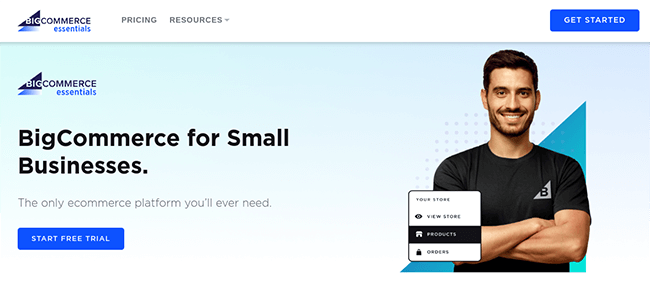
Everything you require to manage your online store is offered by BigCommerce. Without any coding or design experience, creating a stunning online storefront is a breeze with the drag-and-drop website builder.
Choose a theme or template first (there are a ton of amazing free and paid alternatives available, all of which are entirely customisable) and proceed accordingly. You can also adjust the HTML and CSS if you want greater control over the design and want to play around with the coding.
Numerous integrated marketing and sales tools are available to assist you in increasing sales. These include of automated shopping cart recovery tools, simplified one-page checkout processes, image optimization (which speeds up page loading), and more.
From a marketing perspective, BigCommerce comes with built-in SEO capabilities like robot.txt access, customized URLs, and blog support, which you can use to publish posts that drive organic search traffic as part of your SEO plan. To reach more clients, you may also integrate BigCommerce with online marketplaces like as Amazon, Facebook, and Google.
BigCommerce also offers all the necessary tools for managing your online business, such as systems for shipping, payments, and inventory control. There are more than 55 supported payment providers, so you can select one that best fits your needs. If you also run an offline store, you can integrate BigCommerce with your retail POS systems like Square or Vend.
| Pros | Cons |
| Easy-to-use | More expensive than some other platforms |
| Easily integrates with Amazon and Facebook | |
| Support for a blog |
Pricing:
Plans start from $39/month (save 25% with an annual subscription). 15-day free trial available.
#4 – Squarespace
Squarespace isn’t just an ecommerce platform. Rather, it’s an all-in-one content management system designed for any kind of website, including ecommerce stores.

What makes Squarespace great is its curated list of industry-leading website templates. They’re the most well-designed templates we’ve seen on any platform, with well-chosen color palettes, cutting-edge designs, and awesome fonts. This makes it the perfect platform for showcasing visual products (e.g. photographs, art prints, etc).
All templates are included for free with your Squarespace plan (they’re at least as good as the paid templates on other platforms) and there’s something to fit every type of business.
Once you’ve chosen a template, store setup is a breeze. You just add your products, setup payment processing, customize your categories and content using the website builder, and then start driving traffic and making sales. Squarespace also comes with various email marketing and SEO tools to help with that last part.
Despite being a multi-purpose site builder, Squarespace offers plenty of advanced ecommerce-specific features, including:
- Support for subscription sales and digital goods
- Built-in tax tools
- Flexible fulfillment options
- Abandoned cart recovery
- Integration with popular payment processors and shipping services (e.g. Apple Pay, PayPal, UPS, FedEx, etc.)
- Offline and online sales channel synchronization
- A Squarespace app for mobile inventory tracking and customer communication
- POS on iOS
The biggest downside of Squarespace is it isn’t very flexible. It offers very limited integration with third-party apps compared to Shopify. There are only a couple of dozen Squarespace apps to choose from, compared to 6000+ on the Shopify app store.
| Pros | Cons |
| Industry-leading website templates | Limited integrations |
| Built-in tax tools | |
| Built-in email marketing and SEO tools |
Pricing:
Squarespace plans start at $12 per month + 3% transaction fees on sales, or $18 per month with no transaction fees.
#5 – Weebly
Weebly is another multi-purpose ecommerce website builder with an ecommerce platform built-in. It’s very affordable and ideal for entrepreneurs and small businesses that want a low-cost platform that can scale with them.

Weebly might not offer as sophisticated a feature set as some of the other platforms on this list, but it does simple really well. It offers some of the cheapest paid plans on this list, and even a limited free plan.
Weebly offers all the essential tools you need to start selling, including an intuitive drag-and-drop website builder, smart marketing tools (including customizable ecommerce welcome and abandoned cart email templates), basic analytics, real-time shipping rates, and inventory management tools (bulk product imports and exports).
On top of that, it also offers some advanced tools like a coupon and gift card builder, product search, and support for product badges (e.g. ‘low stock badges’) to help make products on your site stand out.
The downside of Weebly is that it isn’t as flexible as some of the other platforms on this list, and is very limited in terms of integrations. It only supports a few payment processors including Square, Stripe, and PayPal.
| Pros | Cons |
| Very affordable | Less advanced features than some other platforms |
| Built-in coupon engine | No ecommerce features on cheapest plans |
| Easy to use |
Pricing:
Weebly offers a free plan, but it’s very limited and only includes a Weebly subdomain (e.g. yourdomain.weebly.com), which isn’t appropriate for serious businesses. It also doesn’t include any ecommerce features.
Paid plans that are suitable for online stores start at $12 (Pro plan). Cheaper plans are available but they don’t include ecommerce features.
#6 – Wix
Wix is another popular, multi-purpose website builder with built-in ecommerce functionality.
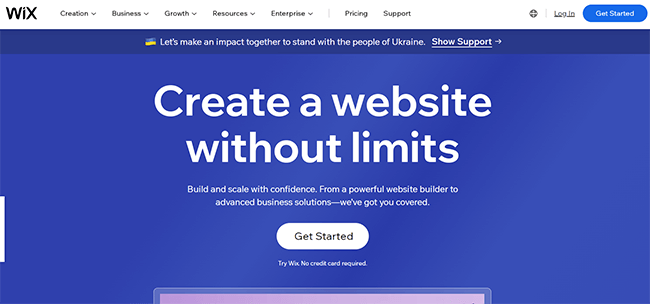
It’s one of the most beginner-friendly platforms on this list and offers a simple, affordable, hassle-free solution for solopreneurs and SMBs that want to get started quickly.
The two things we like most about Wix are its website builder, the ‘Wix Editor’, and its powerful built-in automation features. Let’s start with the Wix Editor.
Of all the page builders I’ve used, Wix comes out on top. It’s super beginner-friendly, powerful, and flexible, with an easy drag-and-drop interface. You start by choosing your theme from 500 high-converting store templates and then can customize it with total design freedom.
You’re not limited to boring backgrounds and static images – you can make your site stand out with cool video backgrounds, parallax scrolling effects, and nifty animations.
And if you don’t want the hassle of customizing it all yourself, you can let the Wix ADI (Artificial Design Intelligence) system take care of it for you. All you have to do is answer a few questions and Wix will build a personalized ecommerce website specifically for your business, complete with custom images and text.
That’s not the only automation tool Wix has to offer, either. You can even run automated Facebook and Instagram ad campaigns to promote your online store on social media.
Once you’ve set up the initial campaign, Wix’s powerful machine-learning algorithm will continually monetize your ad performance and optimize them through improved audience targeting to maximize your return on investment.
And of course, Wix also offers all the usual features you’d expect from an ecommerce platform, including plenty of payment processing options, abandoned cart recovery, streamlined checkouts, and even dropshipping and print-on-demand capabilities.
| Pros | Cons |
| Very beginner friendly | Not a dedicated ecommerce platform |
| Powerful automation | |
| Good range of templates |
Pricing:
Wix’s business and ecommerce plans start at $23/month. They also offer a 14-day money-back guarantee.
#7 – Volusion
Volusion is an all-in-one ecommerce solution that powers over 180,000 online stores. It’s not as well known as some of the other platforms on this list – like Shopify and BigCommerce – but it has some of the most powerful in-built marketing and analytics features we’ve seen.

It comes with all the usual features you’d expect from an all-in-one ecommerce platform: a website builder, shopping cart software, etc. However, its marketing and analytics tools are where it really shines.
It enables you to manage your campaigns across multiple marketing channels (SEO, Email, and Social) from one place.
State-of-the-art SEO features give you the best chance of ranking in the results pages and driving organic search traffic. Pages load super fast, and you can manage all your metadata (title tags, URLs, etc) to make sure your product and category pages are SEO-friendly.
Admin social management allows you to link up your Facebook, Twitter, and other social accounts to your online store. You can manage your Facebook, eBay, and Amazon stores from your Volusion dashboard and even publish social posts.
You can also up email newsletters, automated abandoned cart emails, and take advantage of the built-in CRM tools to manage your sales tickets.
Volusion provides robust analytics to give you insights into every aspect of your campaign, website, and sales performance. You can drill down into the data about purchases, abandoned and live carts, CRM tickets, RMAs, etc., or utilize the comprehensive ROI tracking to see which of your marketing efforts are generating the best results.
| Pros | Cons |
| Best-in-class analytics | Not as customizable as some other platforms |
| Awesome social media and SEO marketing tools | |
| Built-in CRM |
Pricing:
Volusion’s paid plans start at $29/month. A 14-day free trial is also available (no credit card required)
#8 – WooCommerce
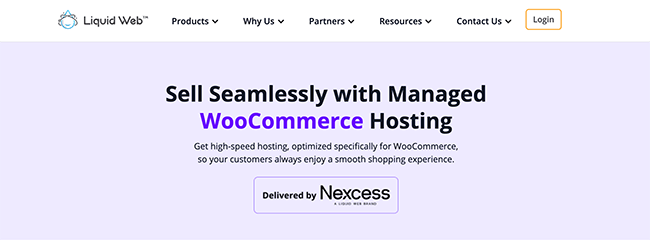
If you want full flexibility and control over your ecommerce store, we’d recommend WooCommerce hosted by Liquid Web. WooCommerce is a flexible, self-hosted ecommerce solution that runs on WordPress.
WooCommerce is different from the other options in this list in that it isn’t a complete platform, per se. Rather, it’s a plugin that you can install and activate on your WordPress website to turn it into an ecommerce store.
The advantage of this is that it’s totally flexible. WordPress is open-source, with a near-infinite library of third-party plugins that you can install alongside WooCommerce to endlessly extend the functionality of your online store. You have complete control over every aspect.
Another advantage is that the core WooCommerce plugin is totally free. This makes it a low-cost ecommerce solution – especially if you already have your own WordPress website.
The downside is that WooCommerce is self-hosted, which means you’ll need to purchase web hosting services separately before you can publish your site to the internet. For that, we’d recommend Liquid Web – a specialist ecommerce web host that offers managed WooCommerce hosting.
Liquid Web provides the servers you need to power your ecommerce website, plus a whole host of tools and services to help you run your ecommerce store.
Once you sign up, Liquid Web will automatically keep the core WordPress and WooCommerce software up to date for you. It’ll also run daily backups, plugin updates, and malware scans to keep your site safe and secure.
Their powerful cloud infrastructure ensures minimum downtime and rapid page loading speeds. Plus, you’ll even get access to a bunch of other premium plugins and themes at no extra cost, like Astra Pro, AffiliateWP, ConvertPro, Glew.io (for advanced analytics).
| Pros | Cons |
| Complete control and flexibility | More of a learning curve |
| Complete ownership | |
| Hugely extendable with 3rd party plugins | |
| Best for SEO |
Pricing:
Liquid Web managed WooCommerce hosting plans start at $21/month with a 30-day money-back guarantee. Annual discounts available.
#9 – Shift4Shop
Shift4Shop is another great turnkey ecommerce solution that offers a feature-rich website builder, marketing tools, order management, and more.
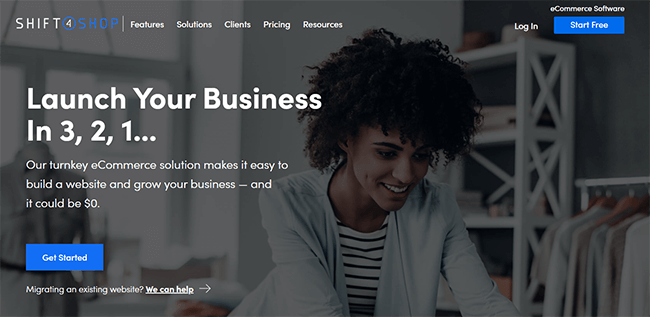
It comes with all the usual features we’ve come to expect from end-to-end ecommerce solutions. But the difference between Shift4Shop and other platforms is that it offers all of that stuff for free!
I’m not kidding, either. Shift4Shop has ‘reimagined the ecommerce business model’ and offers an enterprise-level solution (that’d typically cost $100+ with other providers) for $0 per month. And unlike other free plans, they won’t even limit you to a branded subdomain – you get your own free domain name, SSL certificate, the works!
But I know what you’re thinking – what’s the catch? After all, nothing in life is ever truly free, right?
Well, the catch is that you only get all that for free if you use Shift4 Payments – their own in-house payment processor. This is where they make their money back.
| Pros | Cons |
| Enterprise-level features | Templates feel a little dated |
| Completely free plan available | Only free with Shift4 Payments |
| Tons of integrations |
Pricing:
Shift4Shop is totally free if you use Shift4 Payments. If you’d rather use a different processor, you’ll have to sign up for one of their paid plans, which start at $29/month.
#10 – Big Cartel
Big Cartel is an ecommerce solution built for artists, by artists. It’s been around since 2005 and is used by over a million creators. If you’ve never heard of it before, that’s because they want to keep it that way. Big Cartel is ‘built to stay small and independent’.
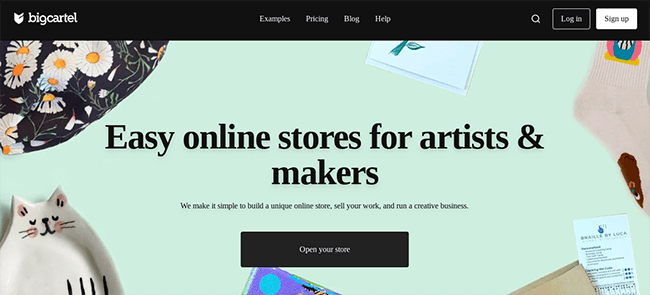
Big Cartel understood that independent creators aren’t usually looking for the same features in their ecommerce stores as SMBs. They wanted to build something specifically to meet the needs of creators, so they prioritized ease of use, design flexibility, and straightforward pricing.
It offers a nice selection of free themes built for artists. All of them are fully customizable – you can tweak the look and feel on the front-end or dive into the code.
It’s also super affordable with a clear, scalable pricing structure. You can sign up for free and upgrade your plan based on the number of products you want to offer in your online store.
Big Cartel also has good ethics policies in place. They’re committed to anti-racism and have a long history of charitable donations to pro-equality causes
In addition to their website builder and checkout solution, you’ll also get access to shipment and inventory tracking, real-time analytics, automated sales tax, support for discounts and promotions, and more.
While the platform is ideal for artists and musicians, it’s not the only one. There are plenty of alternatives.
| Pros | Cons |
| Flexible front-end site builder | Not many advanced features |
| Clear pricing structure | |
| Ideal for artists |
Pricing:
Free for 5 products, paid plans start from $9.99/month.
#11 – Gumroad
Last but not least, we have Gumroad, a useful, free ecommerce platform built for creators who want to sell various types of digital products such as audio files and ebooks.

You can sell pretty much anything with Gumroad: physical products, digital downloads, or even software (Gumroad can generate license keys for you).
Like many of the other platforms on this list, it comes with an intuitive front-end website builder. You can start with a landing page template and customize it until it looks and feels exactly the way you want it to.
You’ll also get access to powerful universal analytics data to help you uncover what’s working and what isn’t, simple automatic workflows, checkout tools, flexible product pricing, support for multiple currencies, and more.
The biggest downsides are that Gumroad features are fairly limited compared to other platforms, and they also take a cut of each sale you make.
| Pros | Cons |
| Powerful analytics | Fees per sale |
| Great for digital products | Limited features |
| Easy to use |
Pricing:
Gumroad is free to use. However, a transaction fee of 10% applies per sale + processing fees.
Specialized Ecommerce Platforms
While general-purpose ecommerce platforms dominate the market, specialized solutions cater to specific business sizes and industries, offering tailored features and optimizations.
A. For small businesses
Small businesses have unique needs and constraints:
- 47% of small businesses spend less than $10,000 on ecommerce solutions annually (Digital.com, 2023)
- 68% of small business owners manage their ecommerce operations themselves (Clutch, 2023)
Platforms catering to small businesses prioritize ease of use, affordability, and essential features:
- Squarespace Commerce:
- Used by over 2 million websites (BuiltWith, 2024)
- Offers all-in-one solutions starting at $23/month
- Example: “Lunya,” a sleepwear brand, grew from a small startup to a multimillion-dollar business using Squarespace
- Wix eCommerce:
- Powers over 700,000 online stores (Wix, 2024)
- Provides AI-driven website creation tools
- Case study: “Amour Vert,” an eco-friendly fashion brand, increased mobile conversions by 23% after switching to Wix
B. For large enterprises
Enterprise-level businesses require robust, scalable solutions:
- 67% of enterprise businesses prioritize customization and integration capabilities (Forrester, 2023)
- Enterprise ecommerce platforms can handle over 10,000 transactions per minute during peak times
Key players in this space include:
- Salesforce Commerce Cloud:
- Used by 19% of Fortune 500 companies for ecommerce (Salesforce, 2024)
- Supports omnichannel selling across 54 countries
- Example: Adidas saw a 35% increase in mobile conversions after adopting Salesforce Commerce Cloud
- Adobe Commerce (Magento):
- Powers 12% of the top 1 million ecommerce sites (BuiltWith, 2024)
- Offers headless commerce capabilities
- Case study: Coca-Cola reported a 20% increase in online sales after migrating to Magento Enterprise
C. For specific industries
Some platforms cater to niche markets with industry-specific features:
- Volusion: Focuses on small to medium-sized businesses
- Used by over 30,000 merchants (Volusion, 2024)
- Offers built-in dropshipping integrations
- Example: “Botanic Choice,” a natural health product retailer, increased conversions by 15% using Volusion’s optimized checkout
- PrestaShop: Popular in Europe, especially for fashion and luxury goods
- Powers over 300,000 active online stores (PrestaShop, 2024)
- Provides multi-language and multi-currency support out of the box
- Case study: “Le Slip Français,” a French underwear brand, achieved 40% year-over-year growth using PrestaShop
- Oro Commerce: Specializes in B2B ecommerce
- Supports complex B2B workflows and pricing structures
- Example: “Berlin Packaging,” a hybrid packaging supplier, streamlined operations and increased online sales by 25% after adopting Oro Commerce
These specialized platforms demonstrate how the ecommerce ecosystem has evolved to meet the diverse needs of businesses across various sectors and scales.
Future Trends in Ecommerce Platforms
The ecommerce landscape is continually evolving, driven by technological advancements and changing consumer behaviors. Here are some key trends shaping the future of ecommerce platforms:
A. AI and machine learning integration
Artificial Intelligence (AI) and Machine Learning (ML) are revolutionizing ecommerce:
- By 2025, 95% of customer interactions are expected to be powered by AI (Servion Global Solutions, 2023)
- AI in retail is projected to reach $31.18 billion by 2028 (Meticulous Research, 2023)
Key applications include:
- Personalized product recommendations:
- Amazon attributes 35% of its revenue to its recommendation engine (McKinsey, 2023)
- Example: Shopify’s integration with Crossing Minds AI increased conversion rates by up to 80% for some merchants
- Chatbots and virtual assistants:
- 70% of customers prefer to use chatbots for simple inquiries (IBM, 2024)
- Case study: H&M’s chatbot on Kik messaging app engages over 300,000 conversations weekly, leading to a 10% increase in online sales
- Predictive analytics:
- Businesses using predictive analytics are 23 times more likely to acquire customers (McKinsey, 2023)
- Example: Walmart uses predictive analytics to optimize inventory, reducing out-of-stocks by 30%
B. Headless commerce
Headless commerce is gaining traction for its flexibility and performance benefits:
- The headless commerce market is expected to reach $3.8 billion by 2027 (MarketsandMarkets, 2023)
- Websites using headless architecture load 29% faster on average (Netlify, 2024)
Key developments:
- API-first platforms:
- Commerce Layer, a headless commerce platform, reported a 300% growth in 2023
- Case study: Chilly’s Bottles saw a 30% increase in conversion rates after moving to a headless architecture with Shopify Plus and Contentful
- Composable commerce:
- Gartner predicts that 60% of digital commerce platforms will use composable architecture by 2025
- Example: LEGO achieved a 42% increase in conversion rates with their composable commerce approach
C. Mobile-first approaches
As mobile commerce continues to dominate, platforms are prioritizing mobile experiences:
- Mobile devices are expected to account for 77% of all retail ecommerce sales by 2025 (Statista, 2024)
- 80% of shoppers use mobile phones inside physical stores to check product reviews, compare prices or find alternative store locations (Google, 2023)
Emerging trends include:
- Progressive Web Apps (PWAs):
- PWAs can increase page load speeds by up to 10 times (Google, 2023)
- Case study: Alibaba’s PWA increased conversions on the mobile web by 76%
- Mobile payments and digital wallets:
- The mobile payment market is projected to reach $6.7 trillion by 2026 (Allied Market Research, 2023)
- Example: Apple Pay transactions grew by 13% in 2023, with over 500 million users worldwide
- Augmented Reality (AR) for mobile shopping:
- 71% of consumers say they would shop more often if they could use AR (Deloitte, 2024)
- Case study: IKEA’s AR app, IKEA Place, has been downloaded over 35 million times, increasing online furniture sales by 25%
These trends highlight the ongoing evolution of ecommerce platforms towards more intelligent, flexible, and mobile-centric solutions, reshaping the future of online retail.
Conclusion: Choosing the Right Ecommerce Platform
As we’ve explored throughout this article, the ecommerce platform landscape is diverse and constantly evolving. Making the right choice can significantly impact a business’s success in the digital marketplace.
A. Recap of key points
- The ecommerce market continues to grow:
- Global ecommerce sales are projected to reach $7.9 trillion by 2026 (Statista, 2024)
- The COVID-19 pandemic accelerated ecommerce adoption by 5 years (IBM, 2023)
- Platform options are diverse:
- Over 250 ecommerce platforms are available in the market (G2, 2024)
- The top 5 platforms (Shopify, WooCommerce, Magento, BigCommerce, and Wix) account for 71% of the market share (BuiltWith, 2024)
- Features continue to evolve:
- 78% of ecommerce platforms now offer built-in SEO tools (SEMRush, 2024)
- 92% provide mobile-responsive themes out of the box (Ecommerce Platforms, 2024)
- Integration capabilities are crucial:
- Businesses use an average of 37 different tools and platforms (Blissfully, 2023)
- 89% of companies cite integration challenges as a significant obstacle to digital transformation (MuleSoft, 2023)
B. Importance of choosing based on specific business needs
Selecting the right ecommerce platform is not a one-size-fits-all decision. Consider:
- Business size and growth projections:
- Small businesses might prioritize ease of use and cost-effectiveness
- Enterprise-level companies often require advanced customization and scalability
- Product type and complexity:
- Digital products may need different features than physical goods
- Businesses with large inventories should prioritize robust product management tools
- Target market and geographical considerations:
- International sellers should look for multi-language and multi-currency support
- B2B companies may need platforms with complex pricing and account structures
- Technical expertise:
- 42% of small business owners cite lack of technical knowledge as a barrier to ecommerce adoption (Digital.com, 2023)
- Consider the availability of support and educational resources
- Budget:
- Ecommerce platform costs can range from $29/month for basic plans to over $300,000/year for enterprise solutions
- Factor in additional costs like themes, apps, and transaction fees
Case Study: “The Sill,” a plant delivery startup, initially used Shopify for its ease of use. As they grew, they migrated to Shopify Plus to handle higher volume and customize their subscription model, resulting in a 600% increase in revenue over two years.
In conclusion, the success of an online business heavily depends on choosing the right ecommerce platform. By carefully considering your specific needs, evaluating the available options, and staying informed about emerging trends, you can select a platform that not only meets your current requirements but also supports your future growth and success in the dynamic world of ecommerce.