
Introduction
In today’s digital landscape, search engine optimization (SEO) is no longer a simple task of tweaking titles and meta descriptions. With increasing competition and ever-evolving algorithms, marketers face several challenges:
- Driving Traffic: How do some websites consistently rank high on search engine results pages (SERPs) while others struggle to gain visibility?
- Meeting User Intent: What strategies can ensure that your content aligns with user expectations and search intent?
Pogrammatic SEO is a sophisticated approach that leverages technology to automate and optimize SEO processes, making them more efficient and scalable.
Consider this: What if you could automate repetitive tasks, freeing up time to focus on strategic initiatives?
This is where programmatic SEO tools come into play. These tools utilize algorithms and data analysis to perform tasks like:
- Keyword Research: Identify high-performing keywords quickly.
- Content Generation: Create optimized content that resonates with your target audience.
- Performance Tracking: Analyze your website’s performance in real-time.
Imagine having a virtual assistant that not only suggests high-performing keywords but also helps you create optimized content and tracks your website’s performance—all in real time.
In this article, we will delve into a selection of leading programmatic SEO tools—Byword.ai, Keyword Chef, Engyne, Bardeen AI, Ahrefs, Typemat, Airtable, ChatGPT, and Plausible.
We will highlight their unique features, benefits, and practical applications, helping you determine which tools best suit your needs.
By the end of this article, you will be equipped with the knowledge to elevate your SEO strategy and explore how automation can simplify your processes while significantly enhancing your online presence.
What is Programmatic SEO?
Programmatic SEO refers to the automated process of optimizing web pages and content for search engines using algorithms and tools. Unlike traditional SEO, which often relies heavily on manual efforts, programmatic SEO allows marketers to scale their strategies efficiently.
Benefits of Programmatic SEO:
- Scalability: Quickly optimize numerous pages. For instance, tools like Keyword Chef can generate thousands of keyword ideas tailored to specific niches, allowing marketers to target multiple keywords simultaneously.
- Efficiency: Save time on repetitive tasks. According to a study by Search Engine Journal, marketers report saving up to 40% of their time on SEO tasks through automation.
- Data-Driven: Make informed decisions based on analytics. Tools such as Ahrefs provide comprehensive data on search rankings, backlinks, and keyword performance, enabling marketers to refine their strategies based on real-time data.
Programmatic SEO involves the use of data, templates, and algorithms to generate a large volume of content that targets specific keywords and search intents. This method allows for the rapid creation of pages tailored to different variations of search queries, often leveraging databases to populate content dynamically:
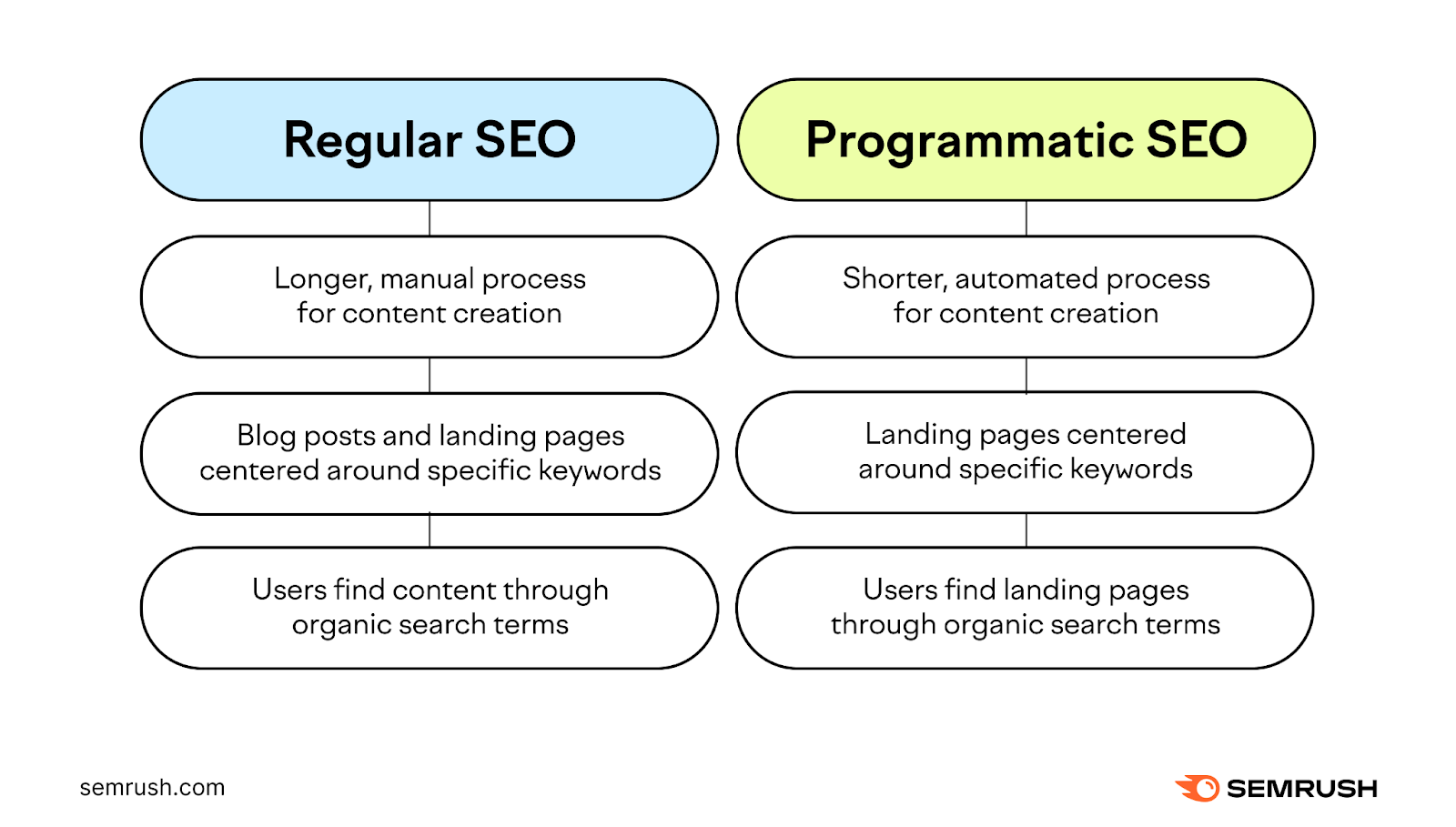
The key advantage is its ability to scale SEO efforts efficiently, making it possible to dominate search results across a broad spectrum of topics and keywords in a short amount of time.
Key Components of Programmatic SEO
-
Data Collection and Analysis:
- Gather data: Collect data from various sources, including search engines, analytics tools, and website data. This data can include keyword rankings, search volume, backlinks, user behavior, and technical SEO metrics.
- Analyze data: Use data analysis tools to identify trends, patterns, and opportunities for optimization. This can involve keyword research, competitor analysis, and technical audits.
-
Automation:
- Task automation: Automate repetitive SEO tasks, such as keyword research, content creation, link building, and technical optimization. This frees up time for more strategic activities.
- API integration: Integrate with various SEO tools and platforms using APIs to streamline workflows and automate data exchange.
-
Optimization:
- Keyword optimization: Optimize content for relevant keywords using tools and techniques like keyword research, keyword mapping, and content optimization.
- On-page optimization: Optimize on-page elements, such as title tags, meta descriptions, header tags, and image alt text, to improve search engine visibility.
- Technical optimization: Address technical SEO issues, such as website speed, mobile-friendliness, and XML sitemaps, to enhance user experience and search engine crawlability.
- Link building: Develop and implement strategies to acquire high-quality backlinks from reputable websites to improve domain authority and search engine rankings.
-
Monitoring and Reporting:
- Track performance: Continuously monitor website performance and track key metrics like organic traffic, keyword rankings, and conversions.
- Generate reports: Create detailed reports to analyze SEO performance, identify areas for improvement, and demonstrate ROI.
Benefits of Programmatic SEO
- Efficiency and scalability: Automate repetitive tasks, saving time and effort.
- Data-driven decision-making: Make informed decisions based on data analysis.
- Improved consistency: Ensure consistent application of SEO best practices.
- Enhanced scalability: Handle large-scale SEO campaigns efficiently.
- Faster time to market: Accelerate SEO efforts and achieve results more quickly.
Best Programmatic SEO Tools
1) byword.ai ($99/mo)
Byword.ai is a sophisticated tool that makes content creation automatic, making it essential to an effective SEO strategy. It effectively creates thousands of programmatic pages with SEO optimization, utilizing natural language processing to guarantee excellent content.
Byword.ai is perfect for producing landing pages and a lot of content because it raises search rankings and generates organic traffic. This tool is an invaluable resource for any content marketing plan, but it’s especially useful for companies looking to dominate search results and increase their search exposure.
Pros:
- Automated Content Generation: Byword.ai excels at generating high-quality, SEO-optimized content automatically, saving significant time and effort.
- Natural Language Processing: Uses advanced NLP to create content that reads naturally and engages readers.
- Scalability: Can produce large volumes of content quickly, ideal for scaling SEO efforts.
Cons:
- Customization Limitations: May require manual tweaking to align perfectly with specific brand voices or nuanced topics.
- Dependence on AI: The quality of content can sometimes vary, necessitating human review to ensure consistency.
Verdict: crucial for programmatic SEO’s scalability in content production. produces excellent content quickly and effectively optimizes for search engines.
2) Keyword Chef ($20/mo)
Keyword Chef is a potent tool for programmatic SEO keyword research is called Keyword Chef. It assists in identifying search intents and low-competition keywords to increase traffic to your programmatic pages.
Keyword Chef assists users in locating long-tail keywords with strong search intent that can raise their exposure and SERP rankings. Even those with no prior SEO experience may easily operate it thanks to its intuitive interface, which guarantees that your SEO strategy will successfully target relevant keywords and targeted search queries.
Pros:
- Keyword Research: Provides in-depth keyword analysis and research, helping to identify lucrative long-tail keywords.
- User-Friendly Interface: Easy to use, even for those with limited SEO knowledge.
- Niche Focus: Effective in discovering keywords for niche markets, enhancing targeted content strategies.
Cons:
- Limited Features: Primarily focuses on keyword research, lacking broader SEO functionalities like content generation or backlink analysis.
- Subscription Cost: Can be expensive for small businesses or individual users.
Verdict: excellent for locating keywords with less competition. enhances search ranks and offers comprehensive keyword analysis.
3) PageFactory ($39/mo)
PageFactory is necessary for a thorough programmatic SEO strategy because it is made for the mass production of SEO-optimized webpages. PageFactory enables customers to swiftly construct thousands of pages, each customized to individual search queries and search intents, using a single-page template approach:
This is a really helpful tool for directories and e-commerce websites that need a lot of content. PageFactory expedites the SEO process by emphasizing consistency and scalability, increasing search exposure and directing organic traffic to your landing sites.
Pros:
- Bulk Page Creation: Facilitates the creation of multiple pages at once, each optimized for specific keywords.
- Template-Based: Utilizes templates to ensure consistency and quality across all generated pages.
- SEO Integration: Seamlessly integrates SEO best practices into each page, enhancing search engine visibility.
Cons:
- Template Reliance: Heavy reliance on templates can lead to repetitive content if not carefully managed.
- Initial Setup: Requires a learning curve and setup time to effectively use the tool.
Verdict: Perfect for producing SEO-optimized pages in bulk. simplifies and guarantees uniformity in the production of massive amounts of material.
4) Engyne ($49/mo)
With the use of automation and data-driven insights, Engyne is a comprehensive programmatic SEO solution that optimizes several facets of search engine optimization. Engyne provides a multitude of services to improve the ranks of your website, ranging from content development and optimization to keyword research:
Because of its many features, it can be used by both small and large enterprises to effectively expand their SEO operations. Businesses may increase organic traffic, enhance search visibility, and take the lead in search results thanks to Engyne’s programmatic content creation capabilities.
Pros:
- Data-Driven: Utilizes extensive data to inform and optimize content creation, ensuring high relevance and effectiveness.
- Automation: Streamlines many aspects of SEO, from keyword research to content generation and optimization.
- Comprehensive Toolset: Offers a wide range of SEO tools, making it a versatile option for various SEO tasks.
Cons:
- Complexity: May be overwhelming for beginners due to its extensive features and capabilities.
- Cost: Higher price point compared to some other tools, potentially limiting accessibility for smaller budgets.
Verdict: All-inclusive instrument for expanding SEO endeavors. offers data-driven insights and automates a variety of SEO activities.
5) Bardeen AI ($10/mo)
Bardeen AI is an essential tool for any programmatic SEO effort because it is an automation tool made to manage repetitive SEO activities. It quickly and simply interfaces with a range of additional programs and platforms, such as Google Sheets and Google Search Console, to improve productivity and workflow:
Even for individuals with no experience with automation, its user-friendly interface makes it simple to set up and operate. With the help of this application, businesses can streamline their SEO procedures and free up time for strategic endeavors like keyword research and content marketing, which will ultimately increase traffic and improve ranks.
Pros:
- Task Automation: Excels in automating repetitive SEO tasks, freeing up time for strategic planning.
- Integration Capabilities: Integrates with various other tools and platforms, enhancing workflow efficiency.
- User-Friendly: The intuitive interface makes it easy to set up and use.
Cons:
- Specific Use Cases: Primarily focuses on task automation, so it may only cover some SEO needs comprehensively.
- Learning Curve: Some advanced features may require time to master.
Verdict: great for putting tedious SEO activities to autopilot. increases the effectiveness of the workflow and works well with other products.
6) Ahrefs ($249/mo)
With its extensive feature set, the well-known Ahrefs is a vital addition to any programmatic SEO approach. It offers dependable, high-quality data for site audits, backlink analysis, and keyword research—all essential for building SEO pages that work:
Ahrefs helps novices and seasoned SEO specialists optimize their websites for higher search engine rankings and increased search traffic. Ahrefs is essential to any content production and marketing strategy because of its keyword research and search volume analysis capabilities, which help increase organic traffic and search exposure.
Pros:
- Comprehensive SEO Suite: Offers a wide range of tools, including backlink analysis, keyword research, and site audits.
- High-Quality Data: Provides reliable and up-to-date data, crucial for effective SEO strategies.
- User Community: Extensive resources and community support for troubleshooting and learning.
Cons:
- Cost: One of the more expensive SEO tools on the market, which might be a barrier for small businesses.
- Complexity: The breadth of features can be daunting for new users, requiring a lot of time to realize its full functions.
Verdict: Reliable data and SEO characteristics are essential. provides thorough backlink research and keyword research.
7) Typemat ($59)
For content optimization, which is crucial for programmatic SEO, Typemat is perfect. It produces and polishes content to increase its exposure in search results, focusing on particular search intents and generating natural traffic:
Typemat focuses on improving the caliber and efficacy of website content while being accessible to customers with varied degrees of SEO experience thanks to its user-friendly design. This tool is a great addition to any content marketing strategy because it is perfect for producing landing pages that cater to a variety of search queries.
Pros:
- Content Optimization: Focuses on creating and optimizing content for better search engine performance.
- AI-Powered: Uses AI to enhance content quality and relevance, making it more likely to rank well.
- Ease of Use: Designed to be user-friendly, even for those with minimal SEO experience.
Cons:
- Feature Limitations: Primarily geared toward content optimization, lacking broader SEO capabilities like backlink tracking.
- Dependence on AI: May require human intervention to ensure content quality and accuracy.
Verdict: efficient at improving landing pages and content. Typemat increases content relevancy and boosts organic traffic with AI.
8) Airtable ($20/mo)
Programmatic SEO applications can benefit from Airtable ‘s flexibility in managing and organizing massive datasets, as it shares similarities with WP All Import. Because of its adaptable interface, users may customize their data management to meet certain requirements, which makes project management and teamwork easier.
Although it’s not just an SEO tool, Airtable’s content and data point organization skills make it a useful tool for implementing a successful programmatic SEO campaign. In addition to assisting with general SEO efforts, it helps increase search visibility, generate organic traffic, and make sure your programmatic pages are efficient.
Pros:
- Data Management: Excellent for managing and organizing large sets of data, crucial for programmatic SEO.
- Customizable: Highly customizable, allowing users to tailor it to their specific needs and workflows.
- Collaboration: Facilitates team collaboration, making it easy to share and manage SEO projects.
Cons:
- Learning Curve: Can be complex to learn, especially for users unfamiliar with database management.
- SEO-Specific Features: Not designed specifically for SEO, so it may lack some specialized functionalities compared to dedicated SEO tools.
Verdict: flexible in the way it manages data for SEO initiatives. It is adaptable to various requirements and promotes teamwork.
9) ChatGPT ($20/mo)
Content creation for programmatic SEO techniques can be aided by ChatGPT. It is extremely useful when building landing sites and SEO pages because it is excellent at producing pertinent, high-quality content that is targeted to particular search intents. Businesses that use ChatGPT may effectively generate hundreds of pages, improving search rankings and increasing organic traffic.
Pros:
- High-Quality Content: Generates engaging, SEO-optimized content tailored to search intents.
- Scalability: Can produce large volumes of content quickly, suitable for programmatic SEO.
- Customization: Allows for detailed prompts to generate content specific to your needs.
Cons:
- Manual Input Needed: Requires detailed prompts to ensure the content aligns with specific goals.
- Cost: Can be expensive for extensive use, especially for small businesses.
- Dependence on AI: Quality can vary, necessitating human review and editing.
Verdict: useful for producing excellent SEO content. increases content generation and customizes information for particular search intentions.
10) Plausible ($9/mo)
Simple and privacy-focused,Plausible is a web analytics solution that offers valuable information for programmatic search engine optimization. Important indicators like search volume and organic traffic are tracked, providing data-driven insights to improve SEO tactics. Because of its simple interface, Plausible makes it simple to track programmatic page performance and modify strategies as necessary.
Pros:
- Privacy-Focused: Prioritizes user privacy, complying with regulations like GDPR.
- User-Friendly: Easy to set up and use, even for those with limited technical skills.
- Real-Time Insights: Provides actionable data to optimize SEO strategies and improve search rankings.
Cons:
- Limited Features: Lacks some advanced analytics features found in other tools.
- No Free Plan: Requires a subscription, which might be a barrier for small websites.
- Basic Reporting: May not offer the depth of analysis needed for complex SEO projects.
Verdict: User-friendly. Prioritizes user privacy and provides SEO actionable insights.
Here’s a comparison table summarizing the key features, benefits, and pricing of the programmatic SEO tools discussed in the article:
| Tool | Key Features | Benefits | Pricing | Ideal For |
|---|---|---|---|---|
| Byword.ai | AI content generation, keyword optimization | Quickly produces SEO-optimized content | Starts at $49/month | Content marketers, bloggers |
| Keyword Chef | Long-tail keyword discovery, search volume data | Identifies high-performing keywords easily | Starts at $29/month | SEO specialists, content creators |
| Engyne | Automated workflows, task management | Streamlines SEO tasks, saves time | Custom pricing | Teams looking for workflow automation |
| Bardeen AI | Task automation across platforms | Reduces manual data entry, increases efficiency | Free to start, paid plans available | Tech-savvy marketers |
| Ahrefs | Backlink analysis, keyword tracking, site audits | Comprehensive SEO insights and data | Starts at $99/month | SEO professionals, agencies |
| Typemat | Content templates, consistency tools | Ensures quality and uniformity in content | Pricing on request | Content teams |
| Airtable | Database functionalities, project management | Organizes SEO data and content planning | Free tier, paid plans start at $10/month | Project managers, small teams |
| ChatGPT | AI-powered text generation, conversational queries | Assists in content creation and strategy planning | Free tier, paid plans available | All marketers |
| Plausible | Privacy-friendly analytics, user behavior tracking | Clear insights into traffic sources | Starts at $6/month | Small businesses, privacy-conscious users |